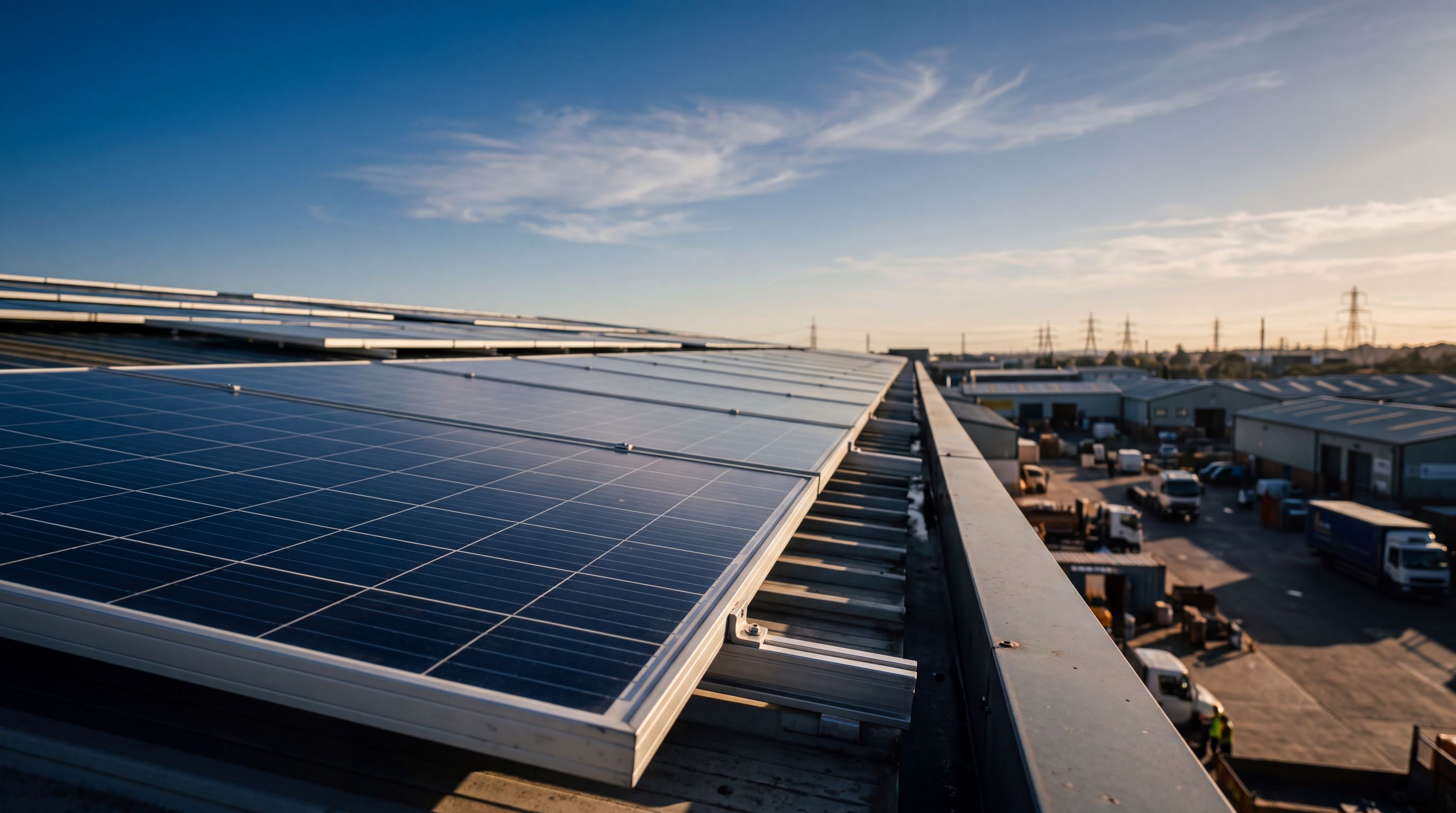
Why generate your own


Buy less from the grid
Daytime generation covers part of what the site uses, so less of it is bought at retail prices.


Know what power will cost
Own the system, or pay a fixed rate for what it produces. Either way, part of your supply stops moving with the market.

Keep running through outages
Paired with storage, solar can carry essential loads when the grid goes down, and trim your peaks when it does not.


Progress you can report
On-site generation is a direct, measurable cut in the electricity you buy, which feeds straight into sustainability reporting.
What Ray builds
Every system is designed around the site’s load profile, its roof or land, and its grid connection, not a standard kit size.
Rooftop and ground-mounted solar
Arrays sized to how the site actually uses power, on the roof, over parking, or on available land.
What we look at: Roof condition and structure, available land, a year of interval data, and your tariff.
Solar plus storage
Batteries that hold daytime generation for the evening peak, back up essential loads, and manage demand charges.
What we look at: Essential loads, backup needs, peak demand, and how the battery would earn its keep.
Industrial systems
Larger, custom configurations for manufacturing sites, integrated with process loads and site compliance requirements.
What we look at: Process loads and shift patterns, electrical infrastructure, and site safety rules.
Operations and maintenance
Monitoring, preventive maintenance and repairs after commissioning, so the system keeps producing what it was designed to.
What we look at: Performance targets, monitoring access, and who maintains what.
Two ways to pay for it
The right structure depends on your capital, your tax position and how long you expect to stay at the site. The assessment compares both before you decide.
No upfront cost
Power purchase agreement or lease
- Nothing to pay up front
- A fixed rate for the power the system produces, or a fixed monthly lease
- Operation and maintenance included
- A performance commitment written into the agreement
- An option to buy the system later
Suits: Sites that want lower energy costs without tying up capital.
Buy the system outright
Ownership
- The system is your asset
- You claim the tax credits and incentives available to owners
- The largest savings over the life of the system
- Pair it with a maintenance agreement, or run it yourselves
Suits: Organizations with capital, and the tax position to use the incentives.
From assessment to operating asset
- 01
Assess the site
Load data, roof or land, grid connection and tariff, and whether solar, storage or demand response fits best.
- 02
Design and plan
System design, production modeling, permits, and the utility interconnection application.
- 03
Build
Procurement and installation by licensed crews, managed to one schedule.
- 04
Commission and support
Commissioning, monitoring from day one, and maintenance for the life of the system.
Some sites end up doing both: solar for what they use, WattRewards for what they can shift. The assessment is where we work out which.
Find out what your roof or land could generate.
Start with a conversation about your site, its load and its space.